Potash affordability gradually worsening on rising import prices
May 1st, 2026 by Logan Collins / Senior Editor - Phosphates, NPKs & Potash


May 1st, 2026 by Logan Collins / Senior Editor - Phosphates, NPKs & Potash
Potash (K) affordability has declined by 2.7% over the last month due to falling crop prices and a steady increase in the MOP import price index.
However, despite the decrease, potash affordability is largely insulated from the drastic declines in affordability recently felt by the other two main fertilizer groups, N (Nitrogen) and P (Phosphate), because of the closure of the Strait of Hormuz.
Overall fertilizer affordability (including N and P in addition to K prices) has significantly worsened over the last month, primarily on sharp increases for nitrogen products. During the market week of 23 April, overall fertilizer affordability reached a lower level than it did during the height of 2022 following Russia’s invasion of Ukraine.
This has negative implications for potash demand, given that K is often the first nutrient that buyers in many of the most price-sensitive markets cut back on.
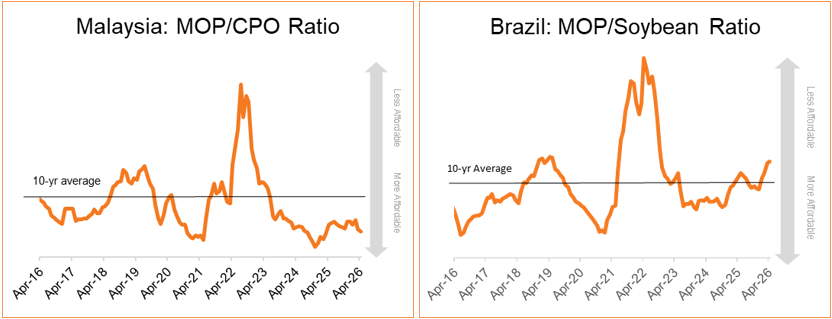
In Brazil, the Paranagua gMOP/soybean barter ratio as of 24 April at 16.9 increased on March due to higher MOP import prices despite small increases in soybean prices. The ratio has increased to its highest level since October 2022 and is above its 10-year average of 14.3.
This is a sizable decrease in affordability from this time last year when the ratio stood at 15. The barter ratio is a measurement of the number of 50kg bags of soybeans required to purchase one tonne of MOP.
Conversely, in Southeast Asia, affordability has improved over the last month as higher MOP prices have been dwarfed by greater increases in palm oil prices.
The MOP/CPO ratio is now at 32.33, down slightly from 33.47 a month prior. This level is well below the 35.33 ratio this time last year and still far below the 10-yr average of 45.3.
As of 24 April, combined CBOT wheat, corn and soybean prices were 18% above their prices entering 2020 (what turned out to be a high K demand year). At the same time, Profercy’s MOP import price index at $377.60pt cfr was up roughly 40% on January 2020.
With global MOP spot prices firming and crop price rises failing to keep pace, potash affordability is gradually worsening.
Affordability for now remains broadly favourable, but further price increases may hit demand in key markets such as Brazil and Southeast Asia over the remainder of 2026.
Logan leads Profercy’s editorial coverage of the phosphates, NPKs and potash markets, delivering market‑focused analysis and price insight. With extensive experience covering global fertilizer markets, he brings expertise in trade flows, supply‑demand fundamentals and cost structures. Logan’s reporting helps subscribers understand key trends and make informed commercial decisions.

Logan Collins
Senior Editor - Phosphates, NPKs & Potash
Provides you with our daily news and analysis, detailed weekly reports and price quotes
Sign Up Today