Brazilian demand in doubt amid difficult global nitrogen supply environment
October 6th, 2026 by Liam Ward / Analyst


October 6th, 2026 by Liam Ward / Analyst
With nitrogen imports lagging previous years, Middle Eastern urea supply still disrupted and Chinese ammonium sulphate (amsul) exports becoming less reliable, Brazilian buyers are entering the key Q4 purchasing period with increasingly limited supply options.
Importers have been buying cautiously with weather and financial difficulties raising concerns over farm-level demand for Safrinha.
This caution has become more pronounced since urea prices hit $500pt cfr in mid to late-September, a level not exceeded since December 2022 when excluding price hikes during the ongoing US-Iran conflict.
Typically, import demand is seasonally strong through Q4, with demand in Brazil and India often dictating global market values during this period.
However, supply disruption and the reluctance to compete for spot tonnes earlier in the year has left Brazilian urea imports lagging well behind previous years.
Basis customs data and anticipated September arrivals, Profercy estimates Brazil would need to import more than 4m. tonnes in Q4 2026 alone to match total 2025 intake at 7.73m. tonnes. Even with weaker or deferred demand, a sizeable import deficit is likely.
Supply from the Middle East, including Iran, made up 37% of total arrivals in Q4 last year, but these volumes have been constrained for much of the year. While vessel movement through the Strait of Hormuz improved in September versus August, flows are still only a fraction of what was possible prior to the start of the conflict.
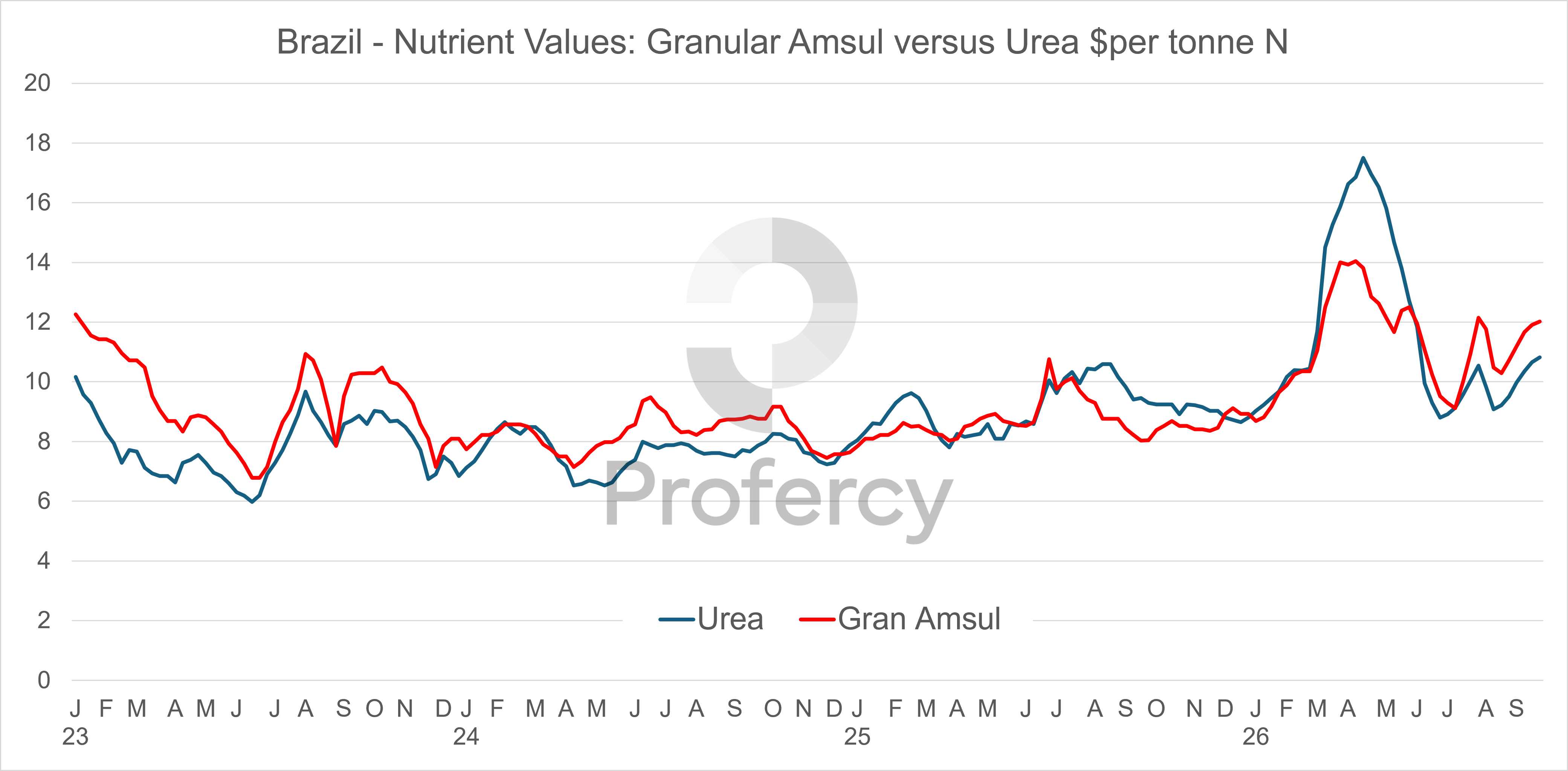
To help offset a shortfall in urea availability, Brazil has increased its intake of amsul which was also more competitively priced (see graph) until June. Amsul imports in January-July were up 2% on the year at a record high for period at nearly 2.9m. tonnes, which was a quarter higher than urea intake during the period.
However, August amsul arrivals more than halved year-on-year as Chinese supply has been disrupted by the implementation of CIQ checks and a quota-based export system. Some have pointed out that delayed July and August cargoes should support larger arrivals into October and November.
Still, the lengthy transit time to Brazil and new regulations mean Chinese amsul is not as dependable a source of supply as it was last year. There is also still no firm clarity around further rounds of Chinese export quotas, adding another layer of uncertainty.
With its supply options limited, any resurgence in local demand would present challenges for distributors and importers, even without competition from India.
Indian demand in Q4 is largely expected to be met by Chinese prilled urea. However, this product is not favoured by Brazilian buyers with Chinese granular availability also insufficient.
As a result, Brazil will be increasingly dependent on African and Baltic supply to cover its Q4 needs.
Deliveries from the Baltic increased by a third on the year to a little over 600,000t in January-August, as punitive tariffs on Russia have reduced flows to Europe.
However, combined arrivals from Algeria and Nigeria have dropped by 42% on the year to nearly 840,000t as those suppliers targeted markets elsewhere offering better returns.
The coming weeks will be a test of whether Brazil feels the need to truly compete for Q4 arrivals or whether local buyers are significantly scaling back requirements. Even with lower demand, sourcing product is expected to remain challenging.
Provides you with our daily news and analysis, detailed weekly reports and price quotes
Sign Up Today